The Role of Realtors
In 1919, the Portland Realty Board issued a manual that addressed their constitution, bylaws, and, most importantly in the context of housing exclusion, their Code of Ethics that stated the role of the realtor and their moral obligations. The preamble to the Code of Ethics described and situated the realtor as a man with a substantial amount of power, stating “[t]he Realtor is the instrumentality through which the land resource of the nation reaches its highest use and which land ownership attains its widest distribution. He is a creator of homes, a builder of cities, a developer of industries…” [1]. This rhetoric borders on equating the power of a realtor with god-like abilities, to be the entity that can simply grant a select group of people property and deny others that right. Diving deeper into this power issued in the Code of Ethics, scholar Gene Slater, in his book Freedom To Discriminate, investigates how real estate agents “became seen, and saw themselves, as protectors of what they designated as white neighborhoods” [2]. In this context of protecting, the concept of the white savior and defender echoes through these laws. A part of a broader national association of real estate, the Portland Realty Board became instrumental in the racial exclusion of African Americans from housing and the redlining of the Albina neighborhood through their issued Code of Ethics containing discriminatory and divisive laws, all under the guise of moral righteousness.
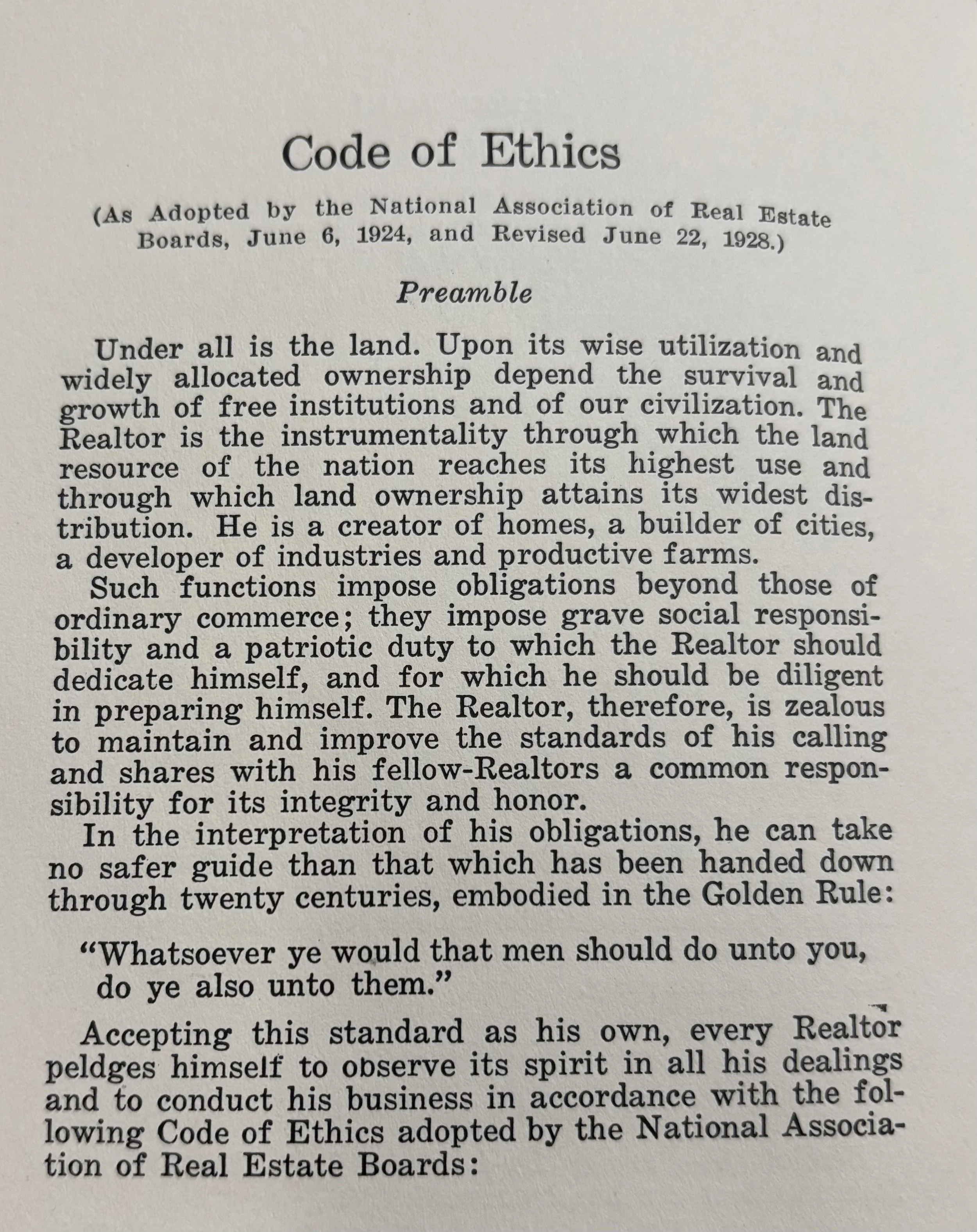
Preamble to the Code of Ethics in the Portland Realty Board manuel, 1919. Oregon Historical Society.
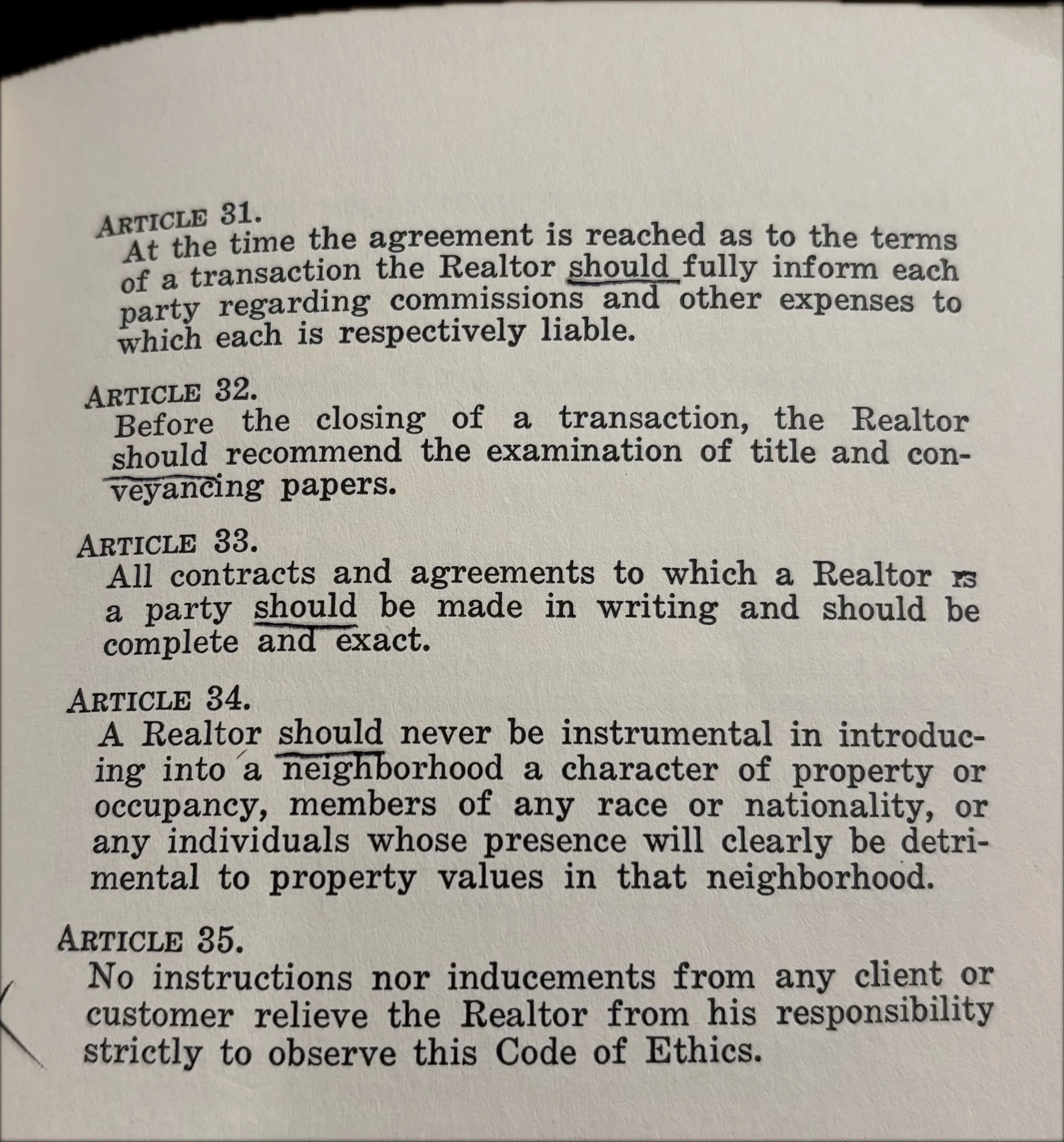
Articles 34 and 35 of Code of Ethics, explicitly embedded racial discrimination into the practice of Portland realtors. Oregon Historical Society.
With moral obligation was heavily written into this Code of Ethics, the preamble highlighted the standards to follow and the responsibility that came with the role of a realtor, stating “[s]uch functions impose obligations beyond those of ordinary commerce; they impose grave social responsibility and a patriotic duty to which the Realtor should dedicate himself…”[3]. At face value, these commitments could have been seen as policies put in place to eradicate discrimination, as the realtor is dedicated to helping the people of his city acquire homes. However, underneath the surface, in looking back at the history of racial exclusion in Oregon seen in the first state constitution of 1857, these ethical obligations are riddled with holes, as the Portland Realty Board also wrote into their laws the blatant ability to discriminate. Article 34 reads, “ [a] Realtor should never be instrumental in introducing into a neighborhood a character of property or occupancy, members of any race or nationality, or any individuals whose presence will clearly be detrimental to property values in that neighborhood.”[4] This law explicitly gave realtors the power to use their judgment to decide who they believed would be a ‘good fit’ for a neighborhood and allowed them to deny anyone who they thought would be ‘damaging.’ Looking at the moral obligations and duties that a realtor must have abided by, this policy exposes the social ideas and racial hierarchies of the time. Thus, for a realtor to have acted within these guidelines, he would have been thought of and seen as a protector for racial excluding a potential Black buyer looking to purchase a home in a predominantly white neighborhood.
Returning to the connection that Slater argues between real estate agents and their ideals of protection, the role of the realtor and their moral obligations coincided with the need to defend and justify racial exclusion within land ownership. In analyzing Article 34, the Code of Ethics stated that realtors needed to protect the neighborhood and white families, not just from Black ownership, but from believed damage that would be done to the property itself. Slater writes that “protecting property values made exclusion a noble endeavor, not simply a defense of prejudice or the realtor’s livelihood…maintaining property values thus translated prejudice and self-interest into moral terms.” [5] Masked with the ideals of moral obligations, realtors played a central role in the redlining of Albina as they used the power they were given by law, like the Code of Ethics, and society to racially exclude and deny property to communities of color.
In thinking about the way in which homeowners might have tried to push back against the racial discrimination that was written into the housing laws in Oregon, the Portland Realty Board took steps to further disparage and divide racial unity. Following Article 34, there is a policy that reinforces the power and judgment of the realtor. Article 35 declared, “No instructions nor inducements from any client or customers to relieve the Realtor from his responsibility to observe this Code of Ethics.” [6] The closeness of this article to the one establishing the backbone of redlining isn't a coincidence, as this law expanded the power that a realtor had to not only racially exclude, but further the divide in neighborhoods and deepen the issue of redlining, pitting neighbors against one another. However, despite this division and discrimination done by housing laws, the Black community of Albina was not passive in the fight against racial exclusion. Understanding the importance and crucial role housing played, the NAACP Credit Union, located in Albina, housed the office of Henry Plummer, who was the only Black real estate agent in Portland at the time [7]. Understanding the power within the role of the realtor that could be used to advocate for the community of Albina, Plummer represented African Americans fairly within the housing market.
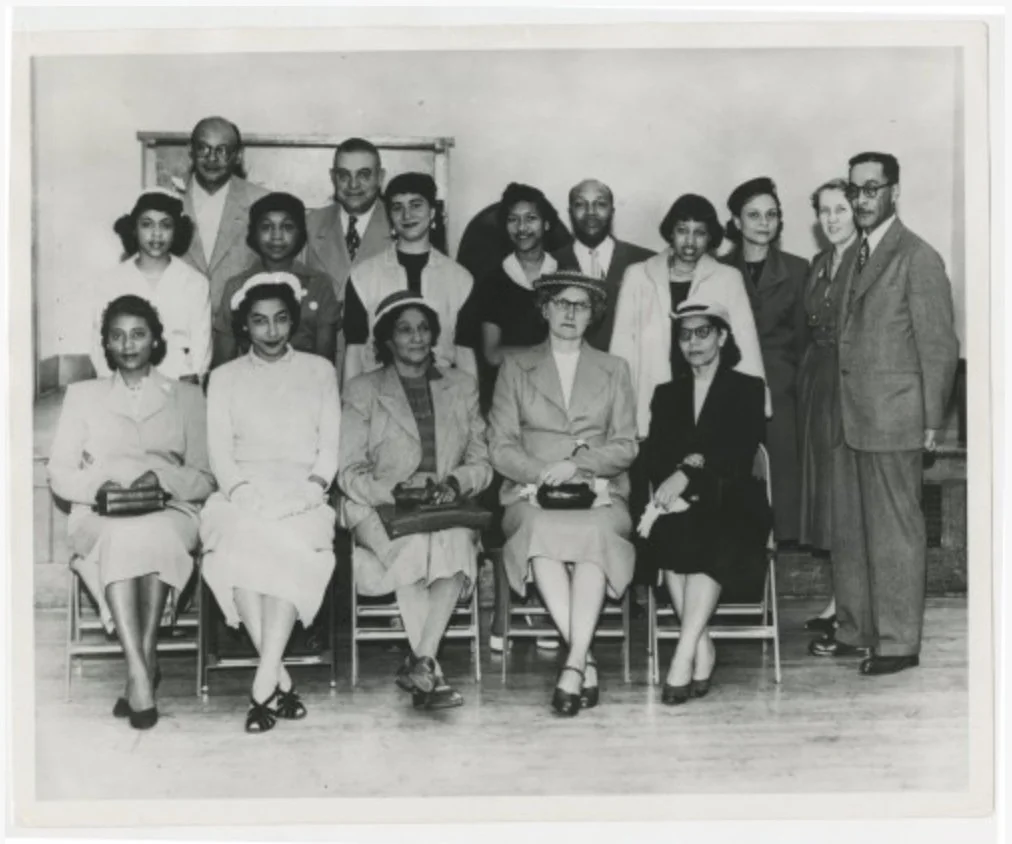
Moving to Portland from El Paso, Texas, Herman Plummer and his wife Lonetta settled in Albina in 1948 and established a real estate business together in 1955 [8]. Standing in opposition to the racial exclusion foundational to the laws of the Portland Realty Board, the Plummers represented African Americans fairly within the housing market, which in turn illuminates the power of the realtor. In an article from the Oregonian in 1953, Herman Plummer stated he “knows of only one real estate board, located in a small Midwest town, which has a Negro broker as a member, and which has taken a stand of non-discrimination in showing houses.” [9] Plummer underscored the role of the realtor in continuing racial discrimination within housing as real estate associations, like the Portland Realty Board, rarely had members of color, barring Black real estate agents from making change from within the system. Becoming the president of the NAACP Portland chapter in 1950, just two years after arriving in Albina, and the president of the Albina Neighborhood Improvement Project in 1969 [10], Herman Plummer was a fundamental figure in the Black community of Albina, advocating for residents and the future of the neighborhood through legal support.
The role of realtors and the exclusionary laws of the Portland Realty Board cannot be understated in the redlining of Albina, seen in moral obligations tied together with the racially discriminatory policies. Through the concepts of land and property, the Code of Ethics of 1919 can be heard as an echo of the exclusionary acts written into the fabric of the state’s legal system and constitution in 1857, as both laws sought to protect Oregon land from anyone but white men to have possession of it. While the Portland Realty Board removed the exclusionary law of Article 34 from the Code of Ethics and their practices in 1958 [8], the four decades of racial discrimination permanently altered the demographic and landscape of the Albina neighborhood.
Sources:
[1] Portland Realty Board: Code of Ethics, 1928, MS 1511, Box 35, Folder 6, Associations and Institutions 1860-2015, Oregon Historical Society Research Library, Portland, Oregon. [2] Gene Slater, Freedom to Discriminate, (Berkley California: Heyday Books, 2021), 87. [3] Portland Realty Board: Code of Ethics, Associations and Institutions 1860-2015. [4] Ibid. [5] Slater, Freedom to Discriminate, 93. [6] Portland Realty Board: Code of Ethics, Associations and Institutions 1860-2015. [7] NoraJane, “Black History Walking Tour of Portland” (walking tour, Oregon Black Pioneers, Portland, OR, June 27, 2026). [8] Jena Hughes, “Historical Context of Racial Planning: A History of How Planning Segregated Portland,” City of Portland Bureau of Planning and Sustainability, September 2019, Accessed July 10, 2026, https://www.portland.gov/sites/default/files/2019-12/portlandracistplanninghistoryreport.pdf.[9] Hugh A. Scott, “Expereicne Related by Negro Home-Owner Shows That Property Values Fail To Suffer,” The Oregonian (Portland, OR), May 12, 1953, Newspapers.com, https://www.newspapers.com/image/1088274834/
[10] Doug Porter, “Herman Plummer Named Albina Center Director,” The Oregon Daily Journal, February 15, 1969, Newspaper.com, https://www.newspapers.com/image/1091970596/.
[11] Jena Hughes, “Historical Context of Racial Planning: A History of How Planning Segregated Portland,” City of PortlandBureau of Planning and Sustainability, September 2019, Accessed July 10, 2026, https://www.portland.gov/sites/default/files/2019-12/portlandracistplanninghistoryreport.pdf
Portland NAACP Staff, cir. 1951 . Herman Plummer stands in the back row, third from the left. Oregon Black Pioneers.