The Exclusionary Landscape of Oregon
In 1857, the Oregon constitutional convention was underway, taking place in Salem, the state’s capital today. In addition to setting up the structure for the branches of government and the boundaries of this new state, the constitutional conventionists were presented with a proposed exclusion law, barring all free Black people from living or owning property in the new state of Oregon. Put to a vote with 8,640 delegates who voted yes and only 1,081 who opposed, [1] the exclusionary law was added to the Oregon state constitution on November 9, 1857. However, this was not the first racially discriminating policy fundamental to Oregon. The decisions that lead to the racial discrimination that was written into Oregon state’s constitution can be traced back to the first sets of exclusion laws passed by the Provisional Government in the territory starting 1843 with the debates over slavery, the visions to create a homogenous new state, and the protection of all land for white ownership being crucial to this narrative.
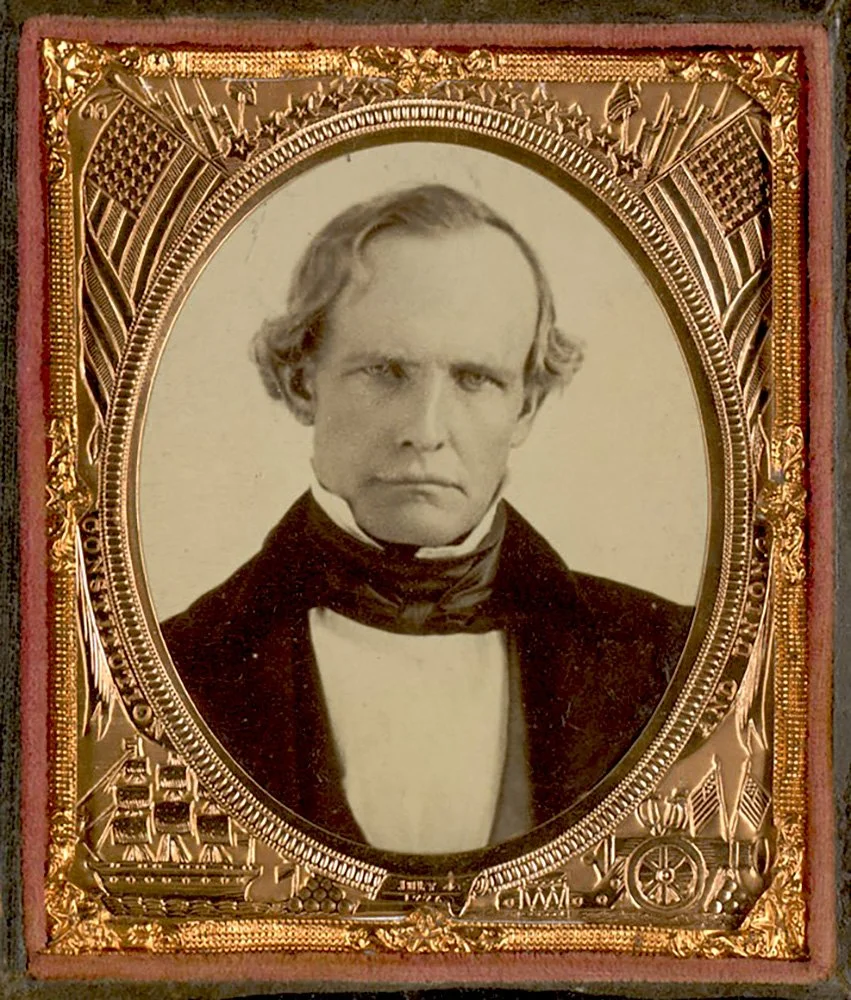
Portrait of Peter Burnett, circa 1860. University of California Berkeley, Bancroft Library.
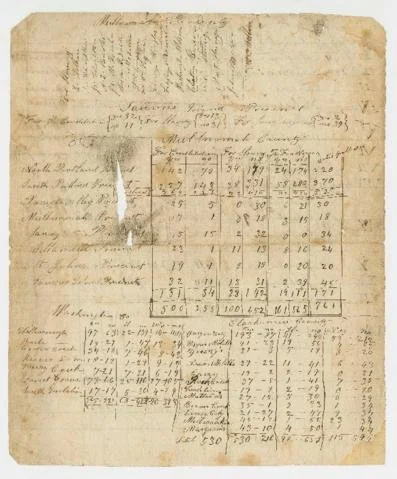
Preliminary votes for the addition of the Black exclusion clause to state constitution, November 1857. Oregon Historical Society.
While officially signed into law with the passing of the Oregon Treaty in 1846 [2], the Oregon Territory — land that makes up present-day Washington, Oregon, and parts of Idaho, Montana, and Wyoming — had been an increasingly sought-after destination for white settlers starting with Lewis and Clark’s expedition in 1803 and then the Oregon Trail migration in 1841. Out of the roughly estimated 400,000 settlers who ventured west on the Oregon Trail, there was a small population of about 12,000 Black pioneers, mostly free workers with some enslaved people brought with white families.[3] This small community, however, did not fit into the white settlers’ racist visions and ideals for this new land. A foundational book to the historiography of Black history and exclusion in Oregon, Elizabeth McLagan originally published A Peculiar Paradise in 1980. She addressed the figure of Peter Burnett [4], a prominent pioneer of the Oregon Trail who would go on to play a powerful role in the Oregon and California government, and Burnett’s racial vision for this new territory, one rooted in Black exclusion and the protection of this new land for white settlers. In 1844, Burnett stated, “‘The object is to keep clear of this most troublesome class of population. We are in a new world, under most favorable circumstances, and we wish to avoid most of these great evils that have so much afflicted the United States and other countries,’” [5]. While moving west and leaving their southern home state behind, pioneers like Burnett viewed these new western territories as an opportunity to continue the racial discrimination and take a step even further to exclude all non-white people from this land.
Burnett’s rhetoric in how he spoke to the power, potential, and ownership of the ‘new’ land in Oregon can be understood within the context of Manifest Destiny. Scholar Kenneth R. Coleman argued in his book Dangerous Subjects that the call to go and claim the land out west on the Oregon Trail was “not an isolated occurrence; it was an early and dramatic product of a deeper imperialist movement later known as Manifest Destiny. The shared objective of the majority of settlers was to impose its collective will and create a self-contained agrarian settlement with little regard for the region’s Indigenous population.” [6] Fueled by the belief it was their god-given right and justified by American exceptionalism, the United States government encouraged white settlers to move west and take the land believed to be rightfully theirs. However, as Coleman stated, the displacement of Native peoples from their homelands was ingrained within the concept of Manifest Destiny and was the first exclusionary measure taken to protect the land for white ownership and the removal of all communities of color.
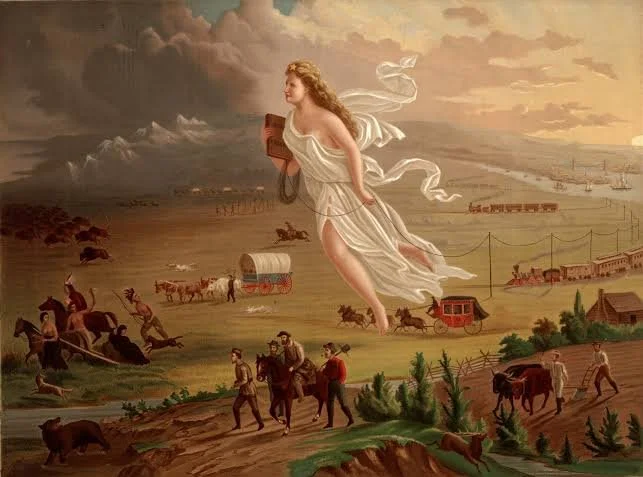
John Gast, American Progress, 1872. This famous painting, one often referred to within addressing Manifest Destiny, depicts an angelic representation of the figure Columbia guiding the white setters to bring the American ideals and progress west. However, the painting with racist portrayals of Indigenous people underscores the violence, greed, and displacement western expedition brought to the land.
Returning to Burnett, his racist stance on the ‘great evils’, race relations, and Black exclusion was commonplace within the Oregon territory. The passing of the Organic Act in 1843 established the Provisional Government for the Oregon territory, an all-white male governing body, and prohibited slavery and all free Black people from the right to vote and freedom to live in the territory. [7] The fact that a foundational document, one which created the first non-Native government on the land, also disenfranchised and excluded African Americans speaks to the discriminatory nature of this new territory. Additionally, while slavery was banned in law but not in practice by 1844 [8], the new governing body was also not interested in becoming a free state. As Gregory Nokes stated in his book Breaking Chains, many of these white settlers, who had left their homes in the slavery entrenched South, “wanted to leave behind not just the culture of slavery, but also African Americans, freed or not.” [9] This all-or-nothing mentality is evident in the strictly exclusionary laws that persisted in the Oregon territory, as laws passed in 1844 and 1849 required Black people who migrated to the territory to leave within three years and made it illegal for a Black person to move to or live in Oregon indefinitely.[10] Put into law by the Provisional Government, these laws spoke to the exclusionary nature of the people in the Oregon territory, sentiments that would be solidified within Oregon’s transition to statehood.
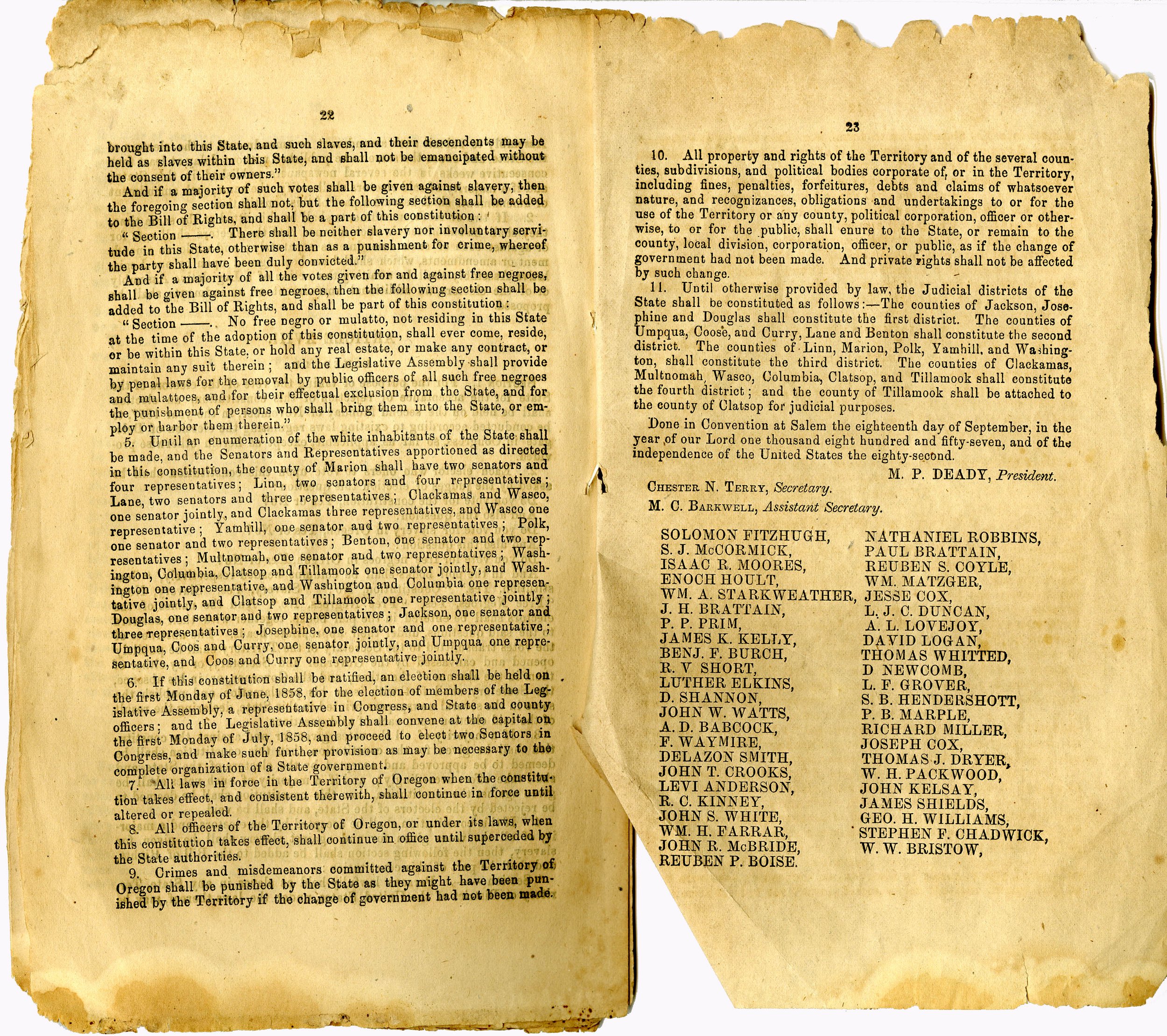
Oregon state constitution, 1857, established the Black exclusionary law. Oregon Historical Society.
Oregon’s first state constitution, written in 1857 and ratified in 1859, can be seen as the final product of the laws that addressed slavery and excluded African Americans from the territory. Section 5 explicitly stated, “No free Negro…not residing in this state at the time of the adoption of this constitution shall come, reside, or be within this state, or hold any real estate…” [11] Not just concerned about the Black people who lived in the state, the constitution exposed a primary focus of the governing body at the time — to protect all land in the state of Oregon for white settlers and ownership. As mentioned before, when put to a vote, the overwhelming majority voted in favor, around 89%, of the exclusion of free Black Americans. [12] Due to this racist stronghold within the state government to intentionally create a homogenous population of Oregon, this exclusionary clause was left in the state constitution until 1926, over six decades later. [13] While not strictly enforced throughout Oregon overall, the damage was done in discouraging and warning African Americans and their families from moving or living in the state. These laws created echoes that can be heard throughout the 20th century in the discriminatory housing policies that led to the redlining and displacement of the Black community within the city of Portland and the Albina neighborhood.
Sources:
[1] Ore. Const. (1857), art. XVIII, sec. 5.
[2] William L. Lang, “Oregon Treaty, 1848,” Oregon Encyclopedia, February 2, 2026, Accessed July 30, 2026, https://www.oregonencyclopedia.org/articles/oregon-treaty/.
[3] NoraJane, “Black History Walking Tour of Portland” (walking tour, Oregon Black Pioneers, Portland, OR, June 27, 2026).
[4] See R. Gregory Nokes, The Troubled Life of Peter Burnett: Oregon Pioneer and First Governor of California (2018).
[5] Elizabeth McLagan, A Peculiar Paradise, A History of Blacks in Oregon, 1788-1940, 2nd edition, (Corvallis: Oregon State University Press, 2022), 25.
[6] Kenneth R. Coleman, Dangerous Subjects: James D. Saules and the Rise of Black Exclusion in Oregon, (Corvallis: Oregon University State Press, 2017), 70.
[7] Barbara Mahoney, “Provisional Government,” Oregon Encyclopedia, February 7, 2023, Accessed July 30, 2026, https://www.oregonencyclopedia.org/articles/provisional_govt_conference_in_champoeg_1843/
[8] McLagan, A Peculiar Paradise, 20.
[9] R. Gregory Nokes, Breaking Chains: Slavery on Trial in the Oregon Territory, (Corvallis: Oregon State University Press, 2013), 47.
[10] “The Black Pioneers,” Oregon Black Pioneers, 2022, Accessed July 30, 2026, https://oregonblackpioneers.org/exhibit/the-black-pioneers/
[11] Ore. Const. (1857), art. XVIII, sec. 5.
[12] “The Black Pioneers,” Oregon Black Pioneers, 2022, Accessed July 30, 2026, https://oregonblackpioneers.org/exhibit/the-black-pioneers/
[13] Greg Nokes, “Black Exclusion Laws in Oregon,” Oregon Encyclopedia, May 17, 2024, Accessed July 30, 2026, https://www.oregonencyclopedia.org/articles/exclusion_laws/