The Redlining of Albina
The term ‘redlining’ originates from the Home Owner’s Loan Corporation (HOLC), which, starting in the 1930s, began surveying cities and created maps that color-zoned neighborhoods based on its assessment of ‘residential security.’ Using the color red, the HOLC explicitly deemed areas where Black families and other historically marginalized communities lived as hazardous or risky. The HOLC and local real estate groups, like the Portland Realty Board, redlined African American residents across the nation into intentional areas, denying financial services like loans as they believed the price of the land and home would decrease in price and value if a Black family were to live there. [1] This racist notion, in addition to being the backbone of the justification of redlining, was centered around the need to protect land, an idea central to the 1857 Oregon state constitution. Thus, beginning in the 1930s and lasting throughout the 1960s, the redlining of Portland’s Black community into the Albina district can be heard as an echo of the exclusionary acts embedded into Oregon’s law almost 100 years prior.
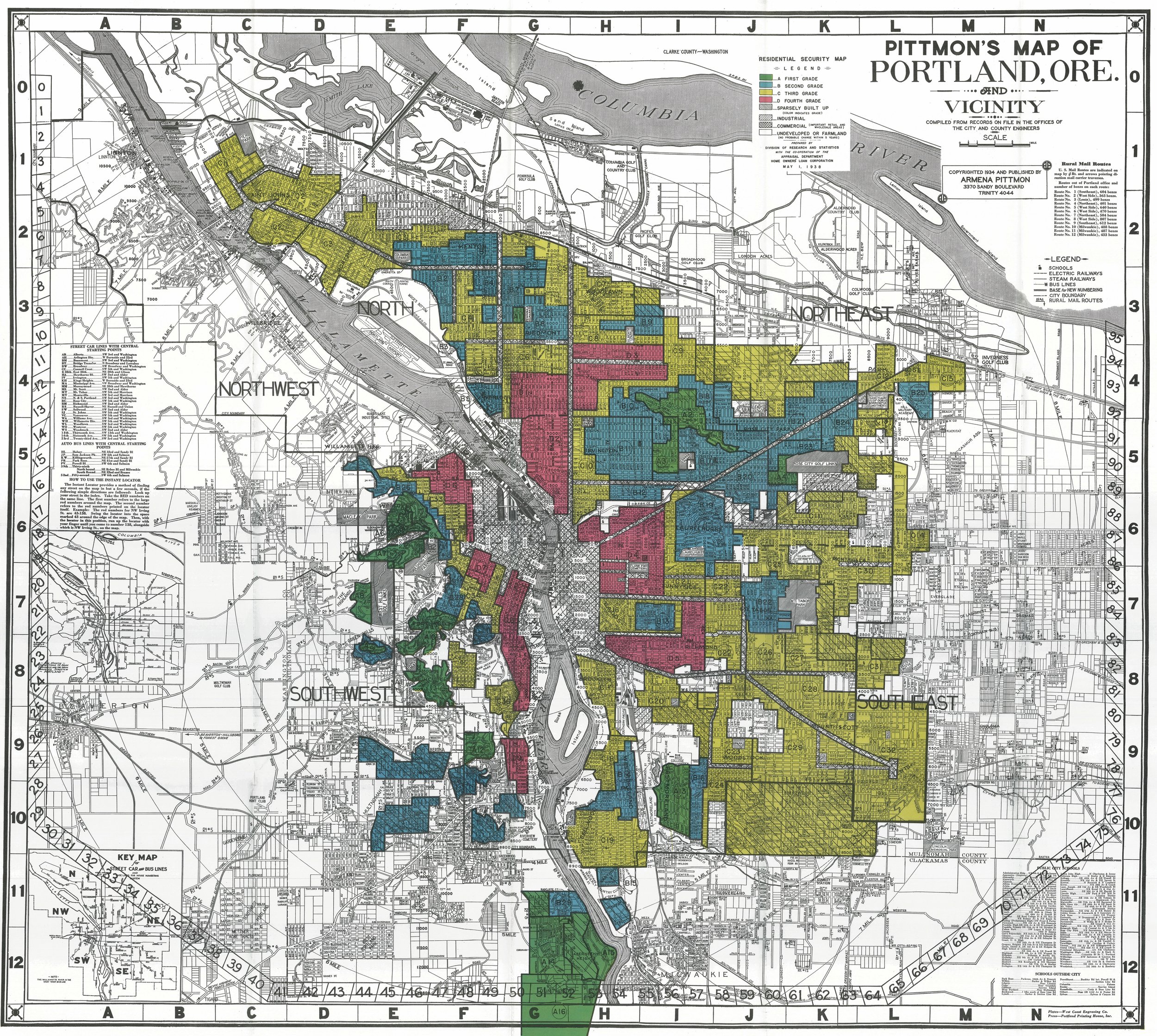
Figure 3, HOLC redlining map, circa 1930s. Mapping Inequality.
The HOLC survey maps were created across cities in the United States, using intentional colors and demeaning terms to describe neighborhoods and determine whether loans would be granted to potential buyers in those areas. Figure 3 is the detailed map of Portland created in the 1930s, clearly outlining the Albina neighborhood in inner-northeast Portland in red. [2] Mapping Inequality, a digital history website dedicated to showing the history of redlining across the country using maps and the status forms, exposes the phrases and words applied to not just neighborhoods in cities, but specific people living in these areas. The status forms created and filled out by HOLC workers used words and phrases such as “encroachment…inhabitants… infiltration of subversive racial population,” [3] in addition to having the various colors be tied to a grading system of the land to descriptive words of “Best, Still Desirable, Definitely Declining and Dangerous.” [4] These dehumanizing and racist descriptions were used to explain the reasoning behind their grade of the area and the need to protect the land from devaluation. As the Albina district was considered dangerous, specifically lower Albina in the Boise and Eliot neighborhoods, the HOLC included justification for their grade decision, stating “[t]his area constitutes Portland’s ‘Melting Pot’ and is the nearest approach to a ‘slum district’ in the city. Three-quarters of the negro population of the city reside here…” [5] Calling out diversity of the neighborhood with racist connotations, these HOLC maps and their survey forms were the backbone of the redlining that took place in Albina.
The Black community was pushed into a small area within Albina as the HOLC, in addition to the Portland Realty Board and white homeowners, made buying homes outside the red lines difficult and potentially life-threatening. Mcelderry records that “[o]n the evening of July 3, 1960, a gasoline bomb destroyed the half-completed home of Rowan and Parthina Wiley, an African American couple with four children,” [6] who purchased land for a home in the Russell neighborhood of northeast, far from the Albina district. This story speaks to the severity of the discrimination and exclusion that Black families faced and the use of violence as a fear tactic. However, the Black community constantly challenged the racial discrimination and worked to uproot the housing exclusionary laws as the beginning of the 1960s opened the door to a decade of fighting for housing justice in Portland. In 1959, led by the local NAACP chapter in Portland located in Albina, a Fair Housing Law that barred discrimination in the sale and rental of houses was passed in Oregon’s state legislature, a part of the broader civil rights acts across the country. [7] Pushing to close the chapter of redlining in Portland and the state of Oregon, in 1967 the NAACP fought for House Bill 1549 to be added onto the bill passed in 1959, in hopes to further deter racial exclusion within housing. Bill 1549 outlawed acts of prejudice and protects all races as buyers, sellers, and renters, and specifically calls the role of the realtor stating, “no real estate broker or salesman shall accept or retain a listing of real property for sale, lease or rental with an understanding that a purchaser may be discriminated against…” [8] While racial discrimination still lurked throughout Oregon and Portland, this bill stood up for African Americans and equality after decades of racist rhetoric held strong within the legal system and the HOLC.
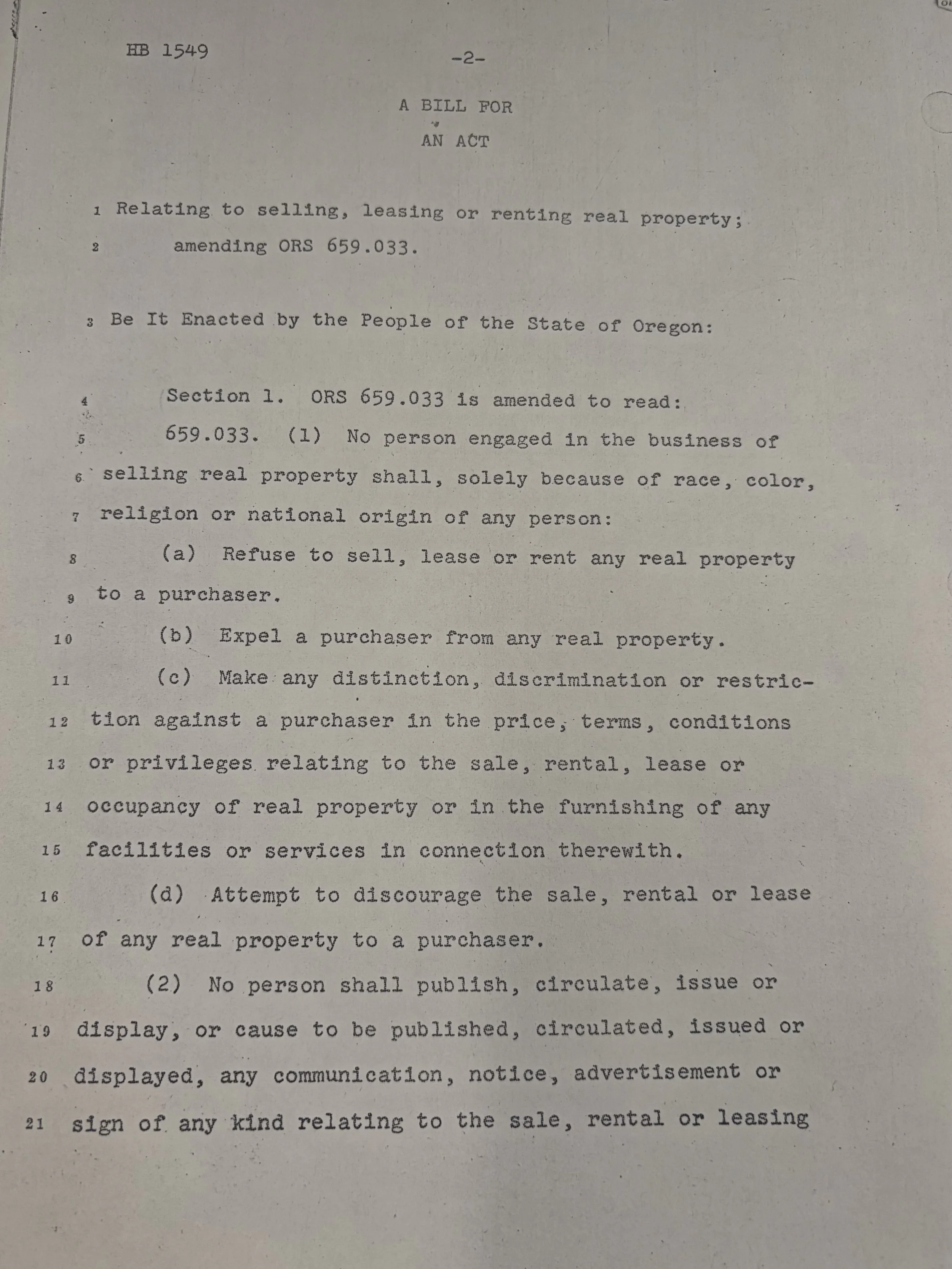
House Bill 1549, passed in 1967. Oregon Historical Society.
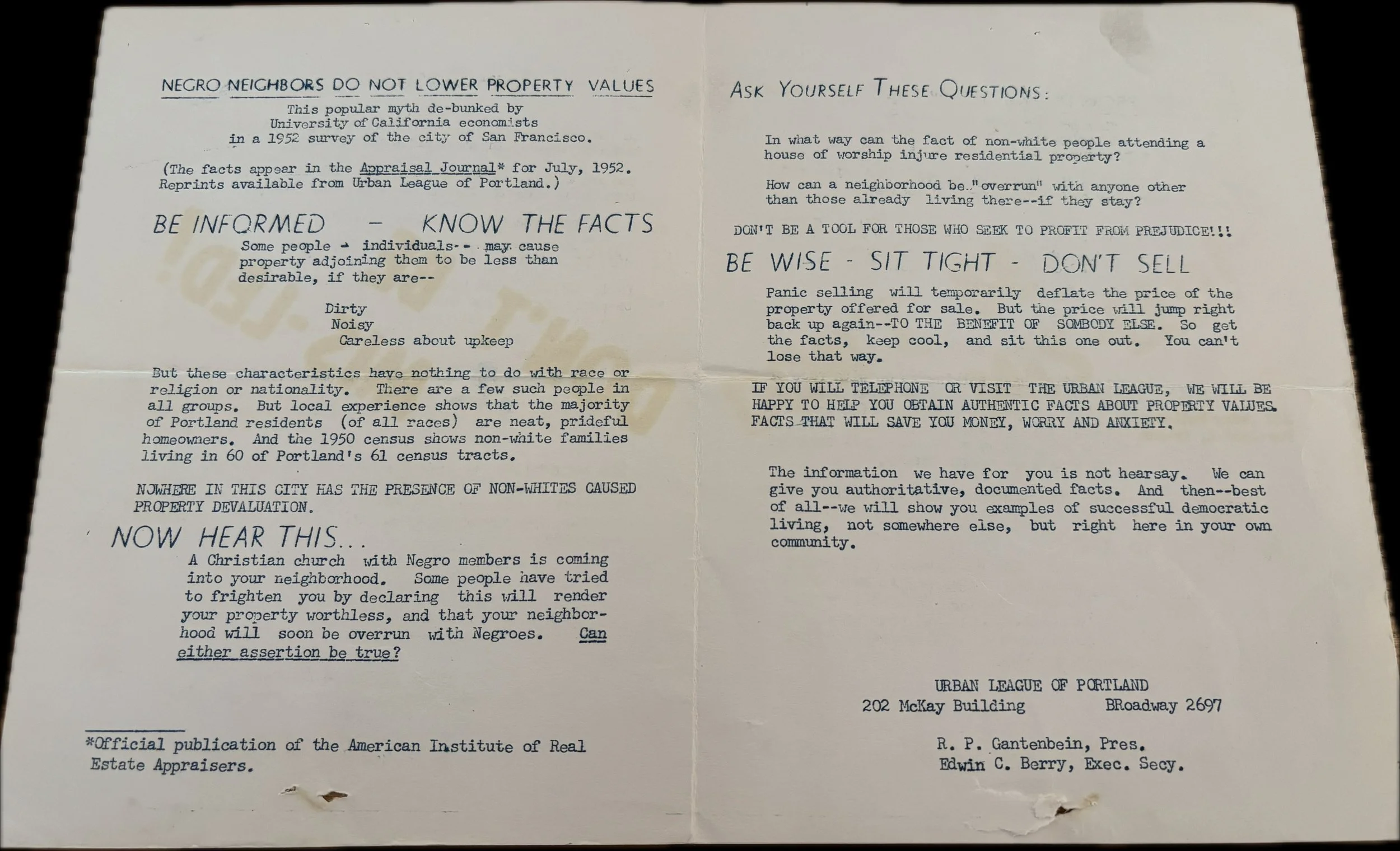
Urban League of Portland flyer, gearing towards educating white owners on the myths of Black homeownership. Oregon Historical Society.
Another social justice organization within the city, the Urban League of Portland, issued a flyer in 1959 titled “Don’t Be Mis-led!” which combated and debunked the false narratives surrounding housing and African Americans and educated readers. The flyer asserted, “Some people - individuals - may cause property adjoining them to be less than desirable, if they are – dirty, noisy, careless about upkeep. But these characteristics have nothing to do with race…There are a few such people in all groups.” [10] Community organizations like the Urban League and the Fair Housing Council not only challenged the racial discrimination within housing rooted in the practices and beliefs of the HOLC and real estate groups but also the exclusionary laws and beliefs written into the fabric of the state’s legal system within the constitution.
Sources:
[1] Karen J. Gibson, “Bleeding Albina: A History of Community Disinvestment, 1940–2000,” Transforming Anthropology 15, no. 1 (2007): 3–25, 5. [2] Mapping Inequality, Portland, Oregon, Mapping Inequality, https://dsl.richmond.edu/panorama/redlining/map/OR/Portland/areas#mapview=full&loc=12/45.5133/-122.6575[3] Mapping Inequality, “Area D2: Lower Albina,” Mapping Inequality, Accessed July 15, 2026 https://dsl.richmond.edu/panorama/redlining/map/OR/Portland/area_descriptions/D2#loc=11/45.5624/-122.5267&scan=3/76.9405/-114.1692 [4] Mapping Inequality, “Area D2: Lower Albina.” [5] Ibid. [6] Stuart Mcelderry, “Building a West Coast Ghetto : African American Housing in Portland, 1910-1960,” The Pacific Northwest Quarterly 92, no. 3 (2001): 137–148, 147, http://www.jstor.org/stable/40492659. [7] Gibson, “Bleeding Albina,” 11. [8] Records of House Bill 1549, 1967, Mss 2004, Box 2, Folder 13, NAACP of Portland, Oregon Records, 1942-1989, Oregon Historical Society Research Library, Portland, Oregon. [9] Greater Portland Fair Housing Council statement “Why Housing Integration is of Crucial Importance to All,” MS 1585 Box 11, Folder 10, Greater Portland Fair Housing Council 1965-1968, Stella Maris House Collection, Oregon Historical Society Research Library, Portland, Oregon. [10] Urban League of Portland Flyer refuting housing myths circa 1952, COLL 963, Folder 1, Urban League of Portland, Oregon Historical Society Research Library, Portland, Oregon.Within the local community of Portland and Albina, community social justice organizations were formed in an effort to combat the discrimination and exclusion happening on the ground. In 1965, the Greater Portland Fair Housing Council was established with the sole purpose of ending the redlining and housing segregation happening within the city and Albina. In a statement titled “Why Housing Integration is of Crucial Importance to All,” they wrote, “Housing segregation is the result of racial discrimination. It exists because those who own, sell, and rent housing practice discrimination, acting out of traditional fears and false assumptions about minority races and property.” [9] The council explicitly called out the issue of redlining and how real estate groups and associations like the HOLC are responsible for creating housing inequality. Additionally, the Fair Housing Council addresses the racist notion that white society believed property value would decrease under Black ownership.