Urban Renewal and Mapping Albina Today
Taken in 1962, this picture on the right shows the bustling main intersection in Albina of Williams Avenue and Russell Street. Despite the exclusion and discrimination of redlining, Albina became the thriving heart of the Black community in Portland. With Williams Avenue as the unofficial main street, Albina was full of Black-owned businesses, restaurants, churches, organizations, clubs, and homes. Music venues and jazz bars, in particular, became popular institutions, rooted in Black culture. The Cotton Club, named and modeled after the original and infamous club in Harlem, New York, opened its doors in the 1960s in the heart of Albina and gained a large following. With performers such as Duke Ellington, Nat King Cole, and Thelonious Monk playing on stage, the owner of the club, Paul Kauls stated in an interview that the Cotton Club was the “only nightclub on the west coast with wall to wall soul.” [1] Speaking to the power and beauty of the Black community in Albina, the Kauls and the Club created a safe space that supported the local community. Ron Steen, a local drummer who grew up blocks away from the Cotton Club, highlighted jazz and music performance as a place to push back against exclusion. He said, in the same interview with Kauls, that “there might be all this racism going on and discrimination, but on the bandstand everyone is equal.” [2] Fueled by the community, Black-owned businesses like the Cotton Club strengthened the neighborhood of Albina through music and connection in the face of discrimination and exclusion.
Businesses like the Cotton Club were impacted by surveys that were conducted by the City of Portland throughout the 1960s that deemed Albina as a ‘blighted’ neighborhood. These surveys and assessments of property allowed the City to put plans in motion to clear specific areas of Albina, forcing residents to leave their homes, neighborhood, and businesses. This displacement of the Black community that happened in Albina was a part of the broader history of urban renewal that swept across the nation throughout the 1960s and 1970s, which targeted neighborhoods and communities of color through the guise of rebuilding these ‘blighted’ areas. Scholars since these renewal projects started in the 1950s have investigated the deeper meaning of ‘blighted’ as a description. In her foundational book written in response to the urban renewal projects affecting communities in New York City, Jane Jacobs in The Death and Life of Great American Cities called out and heavily criticized the use of the term ‘blighted.’ Published during the height of urban renewal in 1961, she stated, “By blight they mean that too many of the college professors and other middle class families steadily deserted this dull and dangerous area and their places were often, quite naturally, taken by those with little economic or social choice among living places.” Jacobs exposed the relationship between neighborhoods deemed blighted and the demographic within the area, which underscored the targeted and racist nature of these urban renewal projects.
In 1962, the same year the picture was taken of the lively main street of Albina, the “Central Albina Study” was conducted by the Portland Development Commission. The commission created an urban planning study that stated that the area of Albina “can perhaps be characterized as a section of the city containing a disordered collection of mixed land, deteriorated and dilapidated buildings, divided by topography and freeway construction…the Central Albina area bears most of the characteristics of a district in an advanced stage of urban blight.” [3]These demeaning descriptive words can be read in parallel to the HOLC redlining forms that addressed the Black community, the people, their homes, and businesses, as dangerous and undesirable.
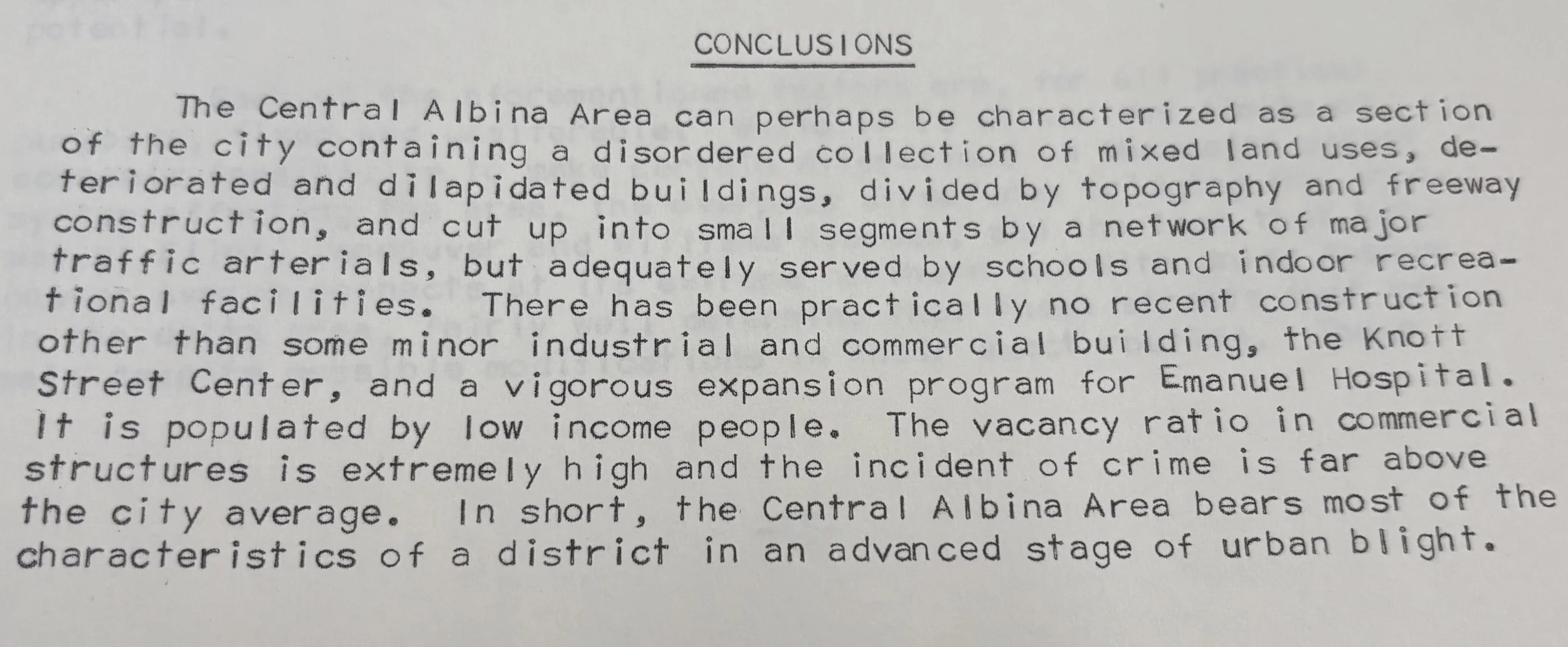
Central Albina Study 1942, conducted by the Portland Development Commission. Oregon Historical Society.
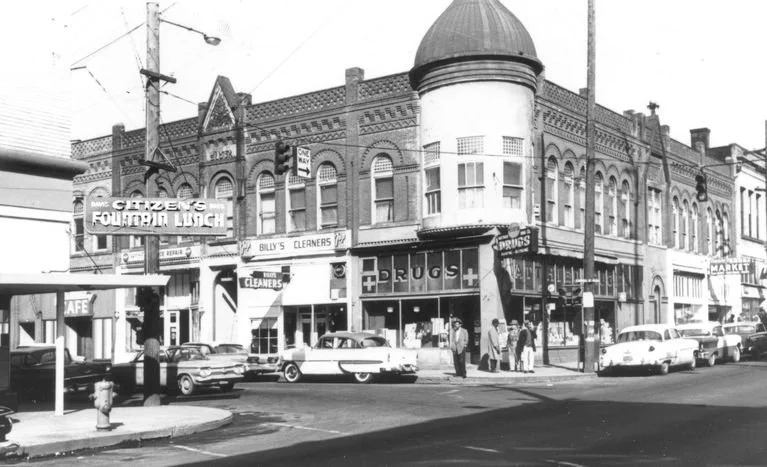
Photo taken of the Williams Avenue and Russell Street intersection, the heart of the Albina community in 1962. Oregon Historical Society.
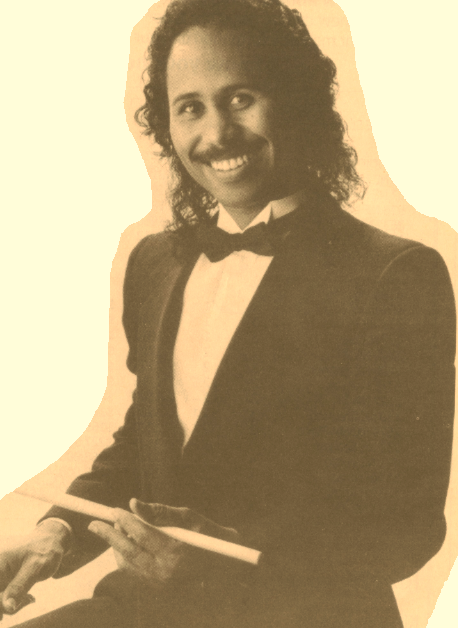
Ron Steen, a local legendary drummer who started his musician journey at the Cotton Club. Eliot News.
However, the justification for why the city believed this neighborhood was blighted was connected to the nature of urban renewal and full of twisted irony. The “Central Albina Study” stated that, at the time, areas in the Albina neighborhood were full of construction as a freeway was being built, which made the areas dangerous and undesirable to live in, thus ‘blighted’. However, the freeway project mentioned was the City-sanctioned construction of I-5 that was purposely planned and placed to avoid the white neighborhoods of downtown and go directly through the heart of Albina. [4] The dark irony within the justification of the“Central Albina Study” conclusions underscored the calculated nature of these projects and urban renewal.
The building of I-5 was one of many urban renewal projects, along with the construction of Memorial Coliseum and the expansion of Emanuel Legacy Hospital, that targeted the Black community in Albina and displaced thousands of African American families from their homes and businesses. [5] The aftermath of these projects and the redlining left visible scars on the land and the history of the Black community in Albina. Thus, the role of place and the memory of the neighborhood is crucial to understanding the exclusion and reviving the community. The StoryMap below works to track the intentional urban renewal projects that displaced the homes and businesses of Black neighborhood and the work being done today to remember and revive the community.
Juxtaposed image of the Mt Olivet Church, located and established in the Albina neighborhood, taken around 80 years apart.